Friday, December 10, 2021

2021-12-10: Dr. Danette Allen Delivers NCSU ECE Commencement Address


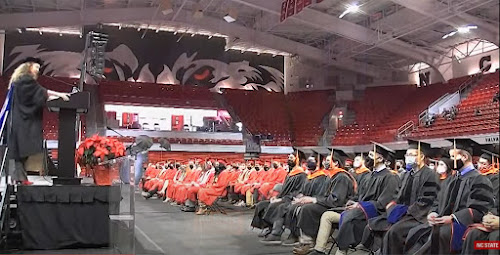
Dr. Danette Allen addresses the NCSU ECE graduating class of Fall 2021

On December 10th, Dr. Danette Allen delivered the commencement address at the NCSU ECE Fall 2021 Commencement Ceremony. She is a proud NCSU alumna with undergraduate degrees in electrical engineering and computer engineering and was honored to return to her alma mater to speak to the up and coming generation of electrical and computer (ECE) engineers. 

Danette on the "big screen" at Reynolds Coliseum

During her 15 minutes of fame, Danette shared three of her favorite colloquialisms: 

  1. Keep your head down and keep coloring!
  2. Keep your eyes on the prize!
  3. Proceed until apprehended!

and closed with the following words of advice:

  • Embrace the power of "yet".
  • Contribute to your 401k.
  • Read "Stranger In a Strange Land".
  • Proceed until apprehended!

If you want to understand how all of these threads tie together, you'll just have to watch her address. The ceremony was nearly 90 minutes long so, if you'd like, skip ahead to 18:58 or go directly to her introduction and remarks.


Friday, June 12, 2020

2020-06-12: Autonomy Incubator Welcomes Summer 2020 Interns

Ai Interns took to video call for the annual group photo.

There's no doubt that 2020 has been a year for the history books. Due to the Coronavirus pandemic, our world has changed dramatically over the past few months, causing many to have to move all of their work home.

The Autonomy Incubator values their internship programs, where undergraduate and graduate students are given the opportunity to gain real-world experience at NASA. Though this summer took an unexpected shift, Ai head Danette Allen made sure to still offer high-quality experiences for this year's interns.

Without further ado, let's meet who will be working with us this summer!

Carson Adcock

First is Carson Adcock, a rising junior Computer Science major at George Mason University. This is his first official internship with the Autonomy Incubator, but he is no stranger to the team. Carson has been volunteering with us since September of 2017.

During his internship, he will be using Blender and Creo to create and polish 3D accurate models for the Ai's simulations.

**TRADEMARK

PHOTO

Next up is Nate Hartley, a senior Computer Science major at Duke University. This is Nate's first summer working with the Autonomy Incubator; however, his sister is Abbey, the former Social Media intern from 2015 to 2017.

This summer he will be working on creating a database and website to display different sensor characteristics as well as helping with human-machine learning experiments.

PHOTO

Third is Amanda Heyman, sister of yours truly. She just graduated from Christopher Newport University with degrees in Psychology and French and will soon begin her graduate studies at the University of Michigan for Social Work.

This summer she will be working with Meghan Chandarana at the Ai, where they will be researching and developing an experiment related to human-machine interaction, focusing on characterizing the cognitive limitations of human operators managing multiple-agent teams.

Payton Heyman

Finally, it is I, Payton Heyman, back for another summer as the Ai's Social Media Intern. After finishing my second year at the Savannah College of Art and Design, I'm ready to bring my social media skills to the test during this virtual internship. Get ready for a summer of green screens and video calls! ;)

It wouldn't be a celebration without a round of high-fives.

We're so happy to still be able to intern this summer despite the circumstances. I look forward to seeing all of the great projects, and we hope you are too! 
Thursday, December 5, 2019

2019-12-05: Herbie Returns to the Ai Flight Space for Another Mission

Kyle McQuarry and Andrew Miloslavsky reset and position the rover
for another day of testing.

Herbie, one of the Autonomy Incubator's (Ai) beloved rovers, was brought back into the flight space again for more rounds of testing today.

The team's goal was to measure the rover's ability to follow a specific mission autonomously.

Andrew and Kyle push code and view the rover's movements
from the control room.

Herbie was built by Ben Kelley in 2015, meaning he turned four years old this fall! He has been through a lot since his creation because of his high adaptability.

Herbie is a fan favorite.

Wednesday, November 27, 2019

2019-11-27: Inertial Transfer Research Uses an End Effector to Catch and Grasp


Intern Justin Goddeau has been working in the realms of inertial transfer as part of the In Space Assembly research at the Autonomy Incubator.

For this demonstration, an end effector had been added to the arm so that it can actually grasp the puck on the air bearing table now.

Watch this short video to see it in action!

Tuesday, November 26, 2019

2019-11-26: MIT Students Visit the Autonomy Incubator for Continued Search and Rescue Research

Katherine, Kyel, and Yulun analyze the programming during the test.

In October, three MIT students visited the Autonomy Incubator again to continue their research with search and rescue missions.

The three students, Katherine Lie, Kyel Ok, and Yulun Tian, have visited several times in the past. In fact, you can read about one of their visits here!

Fortunately for us, the Virginia weather wasn't quite too cold yet, and we could bear the outdoors without the risk of potentially freezing.

The specific goal this time around was to test an integrated real-time exchange of information of the UAVs. The team added two new modifications that are unique to how we normally run our search and rescue tests. The first of which was the person-detection itself, and Loc Tran actually printed a life-sized portrait of his son to act as the lost hiker.

Loc's cardboard-son was our stand-in missing person.

As hysterical as that is, it was actually very successful!

The person detection was running on-board, and they were able to get some great detections of the person and even the co-pilot.

The drone successfully detected the fake Felix.

This was their first time testing with the on-board person detection, rather than off-board, so the drone was actually flying around with a camera and doing the search.

"It was a nice way to tie everything together because now it's doing the actual detecting," Loc said. "It puts a stamp on the search part of the search and rescue mission."

The second modification was "a bit more behind the scenes," as Loc said. Since they were testing with on-board map merging instead of off-board, the two vehicles were creating one map each and then aligning them together to make one unified map. This allows them to share information so that the two drones could differentiate where they've already searched and where they are in space at any given moment. This means they're no longer independent of each other but are integrated.

Before, when the LIDAR was scanning, it was making a 3D map. Now they're doing a 2D approximation and using that to align the two maps.

Other than the MIT students and Loc, there are a few others that had a huge hand in the effort. Chester Dolph has helped out a lot throughout the few years that they have been working on the project.

"It was a smashing success!" Chester said. "It was a really awesome project, and I like that it solved an interesting problem space. Getting all of these sensors to work together in real-time is very tricky, but the MIT folks developed a great code."

Pilots Brian Duvall and Zak Johns are also to thank, as well as Ralph Williams and Chris Meak.

Naturally, the group came together to take a photo at the end of the
research day.

This mission was one of five winners of the AUVSI XCELLENCE Humanitarian Award in May.

Friday, August 9, 2019

2019-08-09: Free Flyers: Autonomous Coordinated Operations


This team of interns are simulating small satellite free flyers for coordinated operations.  The achieved some major things this summer, and I was very happy to capture exactly what they've been working on!

Check it out above!

Thursday, August 8, 2019

2019-08-08: Sarah Woodham: Exit Presentation Summer 2019


Sarah Woodham, a rising senior at Virginia Tech, worked with HFACS (Human Factors Analysis and Classification System) this summer.

Watch her exit presentation to learn more!

2019-08-08: Kathleen Clark: Exit Presentation Summer 2019


Kathleen, or Katie, Clark presented AMP, A Maze Project, where she worked towards understanding human trust in autonomous machines.

This summer, she developed various mazes to test individual differences and communication styles of humans so they can better trust autonomous machines.

2019-08-08: Pathways Intern Ben Hargis on Inertial Transfer for In-Space Assembly


This is Benjamin Hargis' third time interning with NASA, and this summer he is working on several different aspects in regards to In-Space Assembly. More specifically, he is diving deep into the concept of inertial transfer, the passing of an object from one manipulator to the next using the object's own inertia.

One of his main goals is to create a demonstration that incorporates all of the different concepts he and his colleagues have explored this summer.

Watch his Spotlight to learn more!

Tuesday, August 6, 2019

2019-08-06: Nicole Oman's Journey From Nature to Space


Nicole Oman
At the end of July, Nicole Oman will be a part of the Ai for a full year as an Administrative Assistant. After earning her degree in Outdoor Recreation from Northern Michigan University, she did not exactly go down the path she thought she was going to take.

"Life just happens, and sometimes you go in different directions," Nicole said.

After graduating, she began a job in the Newport News area, which led to a position as Administrative Assistant for Christopher Newport University.

After ten years of working for CNU, she decided to find a more career-focused occupation that satisfied her fascination with space exploration. As a result, Nicole is currently working as an Administration Assistant for our very own Autonomous Systems Branch (aka Autonomy Incubator) as well as for the Electromagnetics and Sensors Branch. Here at NASA LaRC, she found an environment that is moving forward in technology, challenges her thinking, and keeps her on her toes. From one branch to another, she can go from processing travel orders to getting approvals to buy hardware and software.

If there is anything to learn from Nicole Oman, its that you become invaluable when you're a creative problem solver and team player.

By NASA volunteer, Trayda Murakami

Monday, August 5, 2019

2019-08-05: Payton Heyman Exit Presentation Summer 2019


This summer, I made cartoons of interns, a video campaign, and hung out with more robots!

With this being my third internship here at the Ai, I had a lot of ideas and goals going into the summer. Watch and listen to my exit presentation, where I discuss the struggles and successes of this season.

2019-08-05: Liam Chapin on Building Software for In-Space Assembly


Liam Chapin is a student at Virginia Tech and a five time NASA intern. Over the years, he has worked on a plethora of robots for the In-Space Assembly project.

Friday, July 26, 2019

2017-07-26: Tyler Garrett, Alex Glandon, and Sami Mian: Exit Presentation Summer 2019


Tyler Garrett, Alex Glandon, and Sami Mian have spent their summer working on simulating small satellite free flyers for coordinated operations.

Watch their exit presentation to learn more about their research! It even includes a sneak peak of a demo!

Thursday, July 25, 2019

2019-07-25: H.O.M.E. Team Exit Presentation Summer 2019


H.O.M.E. stands for Highly Organized Multi-agent Enclosures. Student interns, Chuck Sullivan, Samantha Glassner, and Aaron Shepard worked very closely with Jim Neilan this summer on this project.

Watch their exit presentation to learn about their work with soft robots!

2019-07-25: Jessie Robinson Exit Presentation Summer 2019


Jessie Robinson managed to complete a lot during her 10 week internship here at NASA Langley. She worked closely with augmented reality but experimented with a lot more, as well.

With one of her mentors being Lisa Le Vie, an Ai team member, she worked very closely with our branch. Thanks for everything you've accomplished so far, and good luck starting your Master's program at Virginia Tech!

Tuesday, July 23, 2019

2019-07-23: Jamie O'Brien Exit Presentation Summer 2019


Unfortunately, all internships must eventually come to an end, and our friend, Jamie O'Brien, has nearly reached the finish line.

Watch her exit presentation, where she explains her summer work with the In-Space Assembly project.

Monday, July 22, 2019

2019-07-22: Jamie O'Brien and Her Multi-Agent Inertial Transfer System


This summer, Jamie O'Brien has been working diligently to create a launcher for her multi-agent inertial transfer system.

With only a week left and an exit presentation coming soon, she's been preparing to close out her internship for the summer. Don't get too upset, though, because there's a new spotlight video out, and she's the star!

Thursday, July 18, 2019

2019-07-18: Charles "Chase" Noren Exit Presentation Summer 2019


After many months here at the Autonomy Incubator, Chase Noren's internship has reached the finale. Soon, he will be embarking on a new journey of life, where he will be starting his Ph.D program at Carnegie Melon University!

Watch his exit presentation to learn about his work with In Space Assembly, using scanning LIDAR for local environment mapping.

Friday, July 12, 2019

2019-07-12: Ai Team Member Walter Waltz Gloriously Finishes his Ph.D

Cheers to the month of Walter!

Walter Waltz has been a part of our team for a whole year now, and, along with his anniversary, he also just gained one of the most major victories achievable by man or woman: his Doctor of Philosophy!

This triumph took infinite amounts of hard work and dedication over the past few years.

Walter started his journey at Florida State University, where he received his Bachelor's degrees in Mechanical Engineering and Applied Mathematics. He then proceeded to further his education at the University of Florida, where he received a Master's Degree in Mechanical Engineering and pushed his focus towards robotics for his Ph.D program.

The Autonomy Incubator team is incredibly proud and happy to congratulate him on his success.

Some of us even got to take him out to lunch to celebrate!

Prior to joining us at the Ai, he used to work with many different robots that operated in hazardous environments.  Now, he is part of the In-Space Assembly project! He has been focusing mainly on motion planning so that the robot can successfully undertake each step of the assembly process.  Three important aspects he focuses on include object detection, collision avoidance, and trajectory execution.

This week Walter's parents came to NASA Langley to visit him and see his work in person.  In fact, his father works with robots as well!

Getting a Ph.D is a long and difficult process, so we praise Walter for sticking through the challenge and finishing with nothing but success!

*Queue applause here*

Thursday, July 11, 2019

2019-07-11: Chase Noren on Autonomous Robot Operations for In Space Assembly


Charles "Chase" Noren first came to the Ai in 2017 and has kept coming back ever since.

Learn about his work with autonomous robot operations for the In Space Assembly project!