Monday, March 27, 2017

2017-03-27: Maiden Voyage of the First OWLETS Vehicle


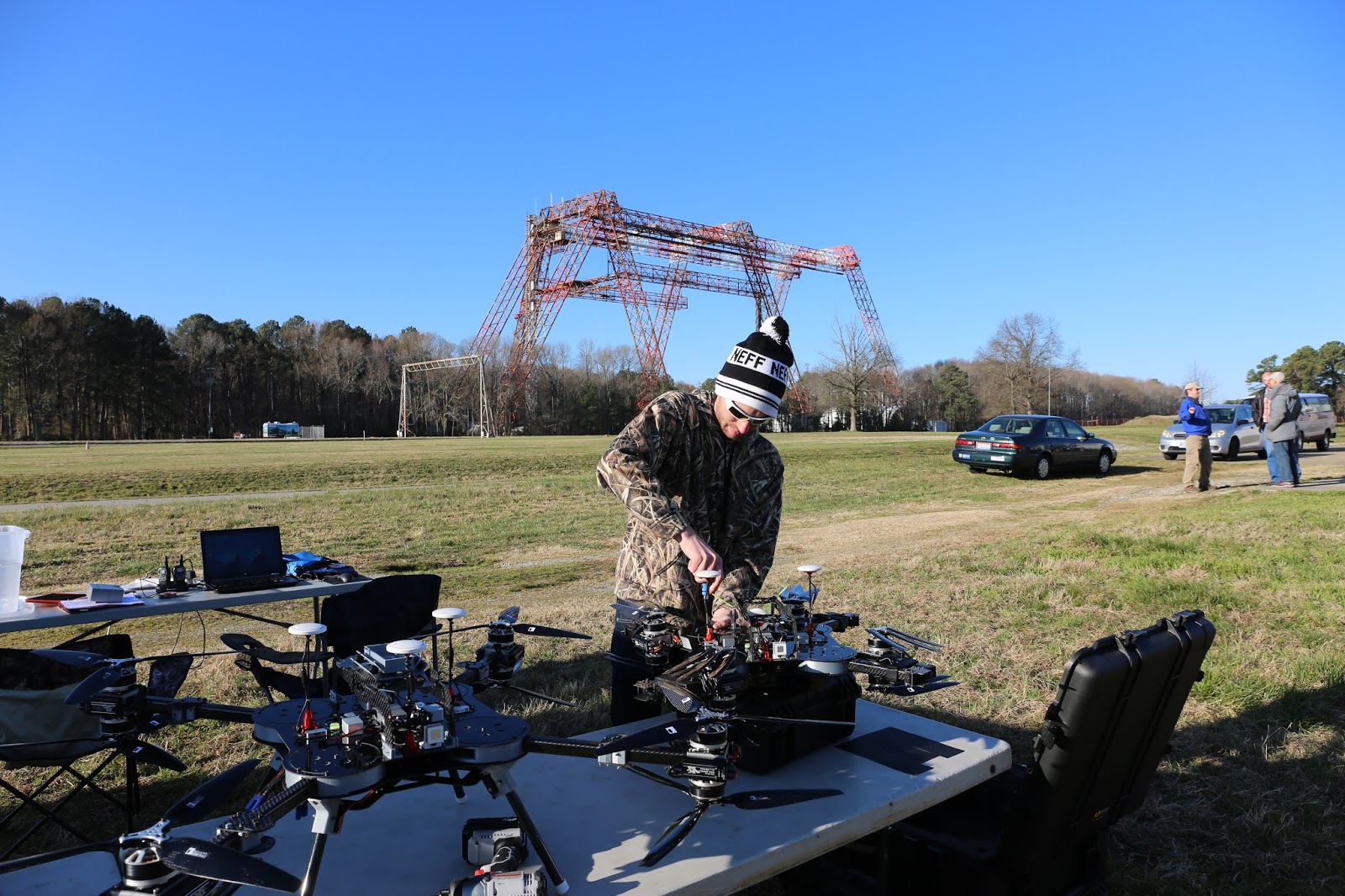
Zak Johns assembles the Hive vehicles in front of the Lunar Lander Research Facility.
Our OWLETS (Ozone Water Land Environmental Transition Survey) atmospheric science mission is moving forward after our visit to the CBBT earlier this month— last week, we flew a Hive vehicle outside for the first time, complete with the full atmospheric sensor suite.

Mounting the ozone sensor to the top of the Hive

Because the sensor package is uniquely shaped compared to our previous research packages (it's tall, and mounted on the top of the vehicle instead of the bottom), we ran these test flights as very short missions to observe the vehicle in-flight. If the sensor affects the flight behavior of the vehicle at all, it's important to find out now so we can mitigate it right away. Longer tests are scheduled for next week, but so far, the vehicle flies beautifully.

Look at that stability!
The atmospheric science team also used the opportunity to test the sensors. Even from the short couple of flights, the data stream looked reliable and accurate.

NASA scientist Guillaume Gronoff examines the ozone data.


Friday, March 24, 2017

2017-03-23: See How We 3D Print Our Way To Better UAVs


Ben Kelley, a small GPS chip in his hand, approached Nick Woodward's desk.

"This is going to go on a vehicle, but I can't find a case for it anywhere online," he explained, handing over the chip.

"I can do that," Nick said.

Nick, an intern and recent grad of Worcester Polytechnic Institute, has many jobs around the Ai, but chief among them is what he calls "the CAD guy." Thanks to what he's accomplished in his three-year stint in the Ai, CAD (computer assisted design) and 3D printing have become a part of everyday operations– which means faster prototyping for our whole lab. Where before people would have had to go outside the Ai to get custom components designed and fabricated, Nick can whip up a quick plastic prototype in less than half a day.


"It provides us with a relatively new and unique advantage of being able to rapidly prototype multiple options for a given solution," he added. So, if he has more than one idea about how to approach a problem, he can just print up both and see which one works best. 

On occasion, Nick sends a successful prototype out to the NASA Langley printing lab because "their abilities for production are way greater than ours... you're looking at a machine the size of a queen bed and about 8 ft tall." Today though, he planned to put his creation straight from our printer onto the vehicle.


It's all measurement taking to start with. Nick uses calipers and takes down the exact dimensions of the chip, noting outlets and screw holes, while he thinks about how to create the best case for it. In less than an hour, he's got a completed first draft.

"If there are multiple parts," he said, "I make sure everything fits together as intended in simulation and then print it out."


Our tabletop printers are extruders, which means they essentially function like very precise hot glue guns– they feed a spool of solid PLA plastic into a heated tip that applies the melted plastic to the work surface in thin layers. The machines are very fast, but also very delicate. Before Nick can fire up the print, he has to make completely sure that the machine is in full working order. This includes cleaning the extruder: cranking the temperature up as high as it goes, letting it cool, and then extracting the purged excess plastic with a pair of pliers.


"What are you doing now?" I asked as he ducked his head practically inside the machine.

"Calibrating," he said. If the extruder head isn't exactly the right distance away from the work surface, or if the axes aren't tuned just right, the print will come out off-kilter. Same for if there's any dirt at all on the surface– before starting the print, Nick has to buff it several times with a paper towel.

"If there's anything between the plate and the PLA when it goes down, it can pull away from the plate mid-print and ruin the print," he explained. There are other ways of making sure your print sticks to the plate– you can rub the printing surface with a glue stick, or coat it with a layer of painter's tape– but Nick prefers to just keep the environment as clean as possible. 


Once everything is ready to go, Nick starts the print and walks away. There's nothing to do now but wait.

"Ideally, you wanna make a print that you can put on in the morning and pick up before close of day, from a prototyping standpoint," he said. The time a component takes to print is dependent on not just the size of the piece, but also the "infill"— basically, how dense the inner honeycomb structure of the print is. Lighter infill pieces print faster, but won't be as hardy. It's a balance Nick has to consider whenever he makes a new prototype.

"I had a twenty-six hour print once," he added. It was the cone and tetrahedron package delivery system he created last summer. 


Once the print is finished, Nick gently pries the pieces off the printer bed and hands them over to Ben. Here he is, assembling the case around the GPS chip.


This first draft turned out pretty well, but Nick said he's doing revisions for a second iteration.

"The inside is about two millimeters too shallow," he said, "and I need to research closing mechanisms that don't require screws." Luckily, a new and improved component is only a few minutes of CAD work and an hour of printing away.

Thursday, March 16, 2017

2017-03-13: Autonomy Incubator Visits Chesapeake Bay Bridge-Tunnel Site for Science Mission


Jim examines the control room.

Jim Neilan, Ben Kelley, and intern Nick Woodward accompanied other representatives from the OWLETS project on a trip to the third island of the Chesapeake Bay Bridge and Tunnel (CBBT) early this morning. The CBBT connects mainland Virginia with the Delmarva peninsula.

Source

The island is where we'll set up our control station and take-off/land for the mission, because it's perfectly situated for ozone sampling on the land-water transition. Why is that so important? Because this mission will be the first time EVER that someone has sampled ozone directly at the transition. In-situ measurement at the land-water transition is completely unprecedented, and we're going to be the ones to do it.

You can almost see Chic's Beach if you squint.

Escorting the team on this excursion was Chief Edward Spencer, the Chief of Police on the CBBT. The bridge-tunnel is so large that it comprises its own "political subdivision" with a police force and special first responders– how cool is that?

The CBBT is giving us the use of this awesome huge garage.

NASA scientist Guillarme Gronoff and an associate discuss sensor placement
with a CBBT employee.

The Hive vehicles carrying ozone sensors, barometers, and other instruments would take off from here, overlooking the north side of the bridge-tunnel, before autonomously flying over open water to take measurements at the land-water transition. It's set to be the largest outdoor mission we've ever flown, as well as the first flight over water.

Don't worry, we're not visible from the road and won't be distracting
drivers with our UAV antics.
Thanks to the CBBT for welcoming us and our robots! We can't wait to get underway with this daring endeavor and start flying some UAVs.

Thursday, March 2, 2017

2017-03-02: Autonomy Incubator Launches Facebook Page


After years of bringing autonomy research to the people through an ever-expanding suite of social media platforms– Twitter, Instagram, YouTube, and of course, this blog– the Ai is thrilled to announce that we finally have a Facebook page. It took years of waiting and building our presence, but we're approved and fully operational!

Of course, with this excellent news, now might be a good time to explore why the Autonomy Incubator puts such unprecedented effort into maintaining an internet presence in the first place. We have a full-time intern (sometimes a staff of interns) dedicated to keeping the public informed about day-to-day operations at the Ai, when most labs might have a Twitter page at most. From my perspective, social media forms a vital part of the Ai's mission as an autonomy lab. How? I'm so glad you asked.

Dr. Danette Allen, the head and founder of the Ai, often says that the our purpose here is, "To enable new missions in science, space, and aeronautics through reliable autonomous operations and human-machine teaming." Essentially, we're developing autonomous robots with the intention that these intelligent machines will someday become a positive part of everyday, civilian life. They'll deliver our packages, they'll find our lost hikers, they'll join our scientific research teams– if we, as a human race, let them. Autonomous machines can only help us as much as we're willing to allow them to help, and therein lies one of the largest problems in autonomy.

People outside of the tech community are often still wary of "artificial intelligence," mostly because of the media surrounding the issue. When I tell people about where I work, a lot of them say something like "So, you're making SKYNET," or "Oh my god, have you seen Black Mirror?" Intelligent machines have a way of capturing the more fearful parts of our imagination, as harbingers of a future marred by our own hubris. A harrowing vision, but one that's difficult to reconcile with the happy little drone that I played keep-away with in our flight range yesterday.


A post shared by NASA's Autonomy Incubator (@autonomyincubator) on


Here's the thing: machines are not inherently evil. Actually, they're pretty great! The capabilities that the Ai and labs like us are developing could vastly improve quality of life for everyone, but not if we're too scared to use them once they arrive. Emerson once wrote, "Knowledge is the antidote to fear." In the technology age, social media is the most effective way to administer treatment.

Through the Ai's social media presences, we're constantly giving the public insights into what we're doing and how we're doing it– breaking down concepts like deep learning and GPS-denied navigation in a way that's accessible to everyone, especially those outside of the tech world.  I focus on writing every blog, caption, and tweet in the clearest language possible so that anyone who comes across us can instantly know what we're doing and, hopefully, want to learn more. We've had some success reaching the average American through our existing platforms, but now that we're on Facebook, our content just became easier to share than ever before.

As we celebrate this new facet of bringing autonomy and humanity together, we–I – profoundly appreciate your support. Every like, follow, and share we get puts our stories in front of new people, and our circle of light spreads just a little further. Thank you for helping us make the future possible.

– Abigail "Abbey" Hartley, NASA LaRC Ai Social Media Intern


Wednesday, February 22, 2017

2017-02-22: Autonomy Incubator Welcomes Swarm of CICADAs

Danette pulls a Cicada from its crate to show PIs Rania Ghatas, Jim Neilan, and Matt Vaughan.

Four boxes of color-coded CICADA gliders arrived from the Naval Research Laboratory before lunch today, and we were all as excited as you'd expect someone who just received 150 tiny flying robots in the mail to be.

Kyle McQuarry with a fresh-from-the-box yellow CICADA.

These little guys will be dropped en masse from the Hive to gather atmospheric data on the upcoming OWLETS mission. Essentially, the Hive will carry them high into the air at the beginning of the route and release all 150 of them at the designated altitude, and then the CICADAs will autonomously navigate to the end point, collecting air quality data the whole way there.

Before that happens, though, we have to make sure they're all flight-ready and fully functional. That duty falls to PI Matt Vaughan.

"I'm checking to make sure that the GPS is working, that it powers on, that it knows right from left," he said. "We also need to check their pairing mechanism, where if you stack them they go into armed-for-flight mode."

Stacked and armed CICADAs.
One of the coolest features about the CICADA is the way they preserve battery life: they don't arm for flight until they're stacked in pairs, when magnets on the front and back ends of each vehicle align. Once they're armed, they don't switch on and start navigating until they're unpaired by the force of free-falling.

"When they separate from each other as they fall and tumble, they'll realize, 'Oh, I'm falling because I'm not paired anymore,' and then they'll enter spin recovery mode, get a GPS fix, and start gliding towards where the waypoint is," Matt explained.

Separated and ready-to-glide CICADAs.

Once the CICADA reaches its GPS waypoint, it enters a spiral pattern around the point until it hits the ground. All of the navigation happens onboard via a GPS sensor and two servos to adjust the wing flaps; communication with the ground station only involves streaming data and status updates of the sensors.

Ben is actually holding the CICADA right side-up—
they fly with the bulk of their bodies underneath them.

Before we can start dropping CICADAs anywhere, however, Matt must overcome one more logistical hurdle.

"I have to charge all of them," he said. "I need a lot of cables and a lot of chargers."

Note: If you're interested in reading more about CICADAs, here's a NRL press release, an article from AFCEA that I found helpful, and here's an AIAA conference paper from NRL explaining the design evolution. 

Tuesday, February 21, 2017

2017-02-09: Autonomy Incubator Collaborates with MIT on Collaborative Search-And-Rescue Vehicles

Loc hand-flies the UAV through the search area.

As part of the collaboration between NASA Langley's DELIVER initiative and MIT's SRTC (Search and Rescue under The Canopy) project, Ai engineer Loc Tran has spent the last two days tromping through the woods in the back half of the center, a UAV held at arm's length in front of him.

"We're recording data," he said before handing me a laptop. He took the UAV on long, looping paths through the forest, while I followed behind him and watched streams of data flow in from the onboard sensors– GPS positioning information, measurements from the lidar on top of the UAV, video from the front-mounted camera. Everything the UAV would need to fly autonomously was already on board; I was just there to monitor that it was working. Houston to the Apollo 11, if you will.

My view from Mission Control.

"So, it's making maps right now?" I asked, as we passed the same bench for the third time.

"Yeah, but what's important is that we're going through the same area in different directions to match up the maps we get," Loc explained.

UAVs have had the ability to navigate and create maps for years now; look at all the PTAM and computer vision research we've already done at the Ai. This UAV is unique in that as it navigates and creates maps, it shares those maps with other vehicles navigating the same area to collaboratively create one big master map. By looping around and crossing through the search area multiple times, Loc can test the map-matching algorithm to verify that it recognizes the same topography from different angles.

"We want to be able to know where one drone has searched versus where another drone has searched," he said. In a search-and-rescue situation, time is a precious commodity. If the team of search vehicles can collaborate in their analysis instead of individually scanning for the same subject, the time saved could be crucial to a successful rescue.

The modern, less cuddly version of a Swiss Saint Bernard.
Once we made enough laps around the search area, Loc took the equipment back to the Ai and prepared the data to send off to MIT.

"This is their design; we're helping them with the operations aspect of it– testing the thing, collecting data and trying [the algorithm] on our own data set," he said. "They don't have woods where they are." Critical in an under-the-canopy search project.

Before the day was over, Loc also switched places with me so I could take the UAV for a joyride. Hand-flying is harder than it looks– the lidar has a 270° field of vision so you have to stay right behind the vehicle to keep out of the way, plus it's heavy– but the information I collected will become part of the project data set. You're welcome, America!

Me, proving that English majors really can do anything.


2017-02-08: Autonomy Incubator Transforms PIs into Pilots


In pursuit of greater efficiency and a deeper understanding of unmanned flight, three intrepid Ai members– Jim Neilan, Ben Kelley, and Matt Vaughan– have volunteered to become UAV pilots. This month marked the beginning of their training under the guidance of Zak Johns, our resident UAV pilot. With more people available to serve as safety pilots during flight tests, we're looking forward to faster turnarounds and decreased demand on Zak as the only (but still best!) pilot around.

"Zak has been a scarce resource," Ben explained. "Whenever we need a safety pilot, we're all competing for his time and his effort, and he has other jobs to do... whenever repairs need to be made or new builds or things like that, Zak's the one who gets tasked with those."

Kyle McQuarry, Matt, and Ben learn how to break down the Hive.
The first day of the introductory course was entirely classroom-based to cover every aspect of UAV assembly and maintenance, from how to check if a motor needs to be replaced– twist it in your fingers and "feel the cogging," Zak says– to the correct way to charge a lithium-polymer battery. Sayer Fisher, lead engineer of the Hive (and former Ai intern!), demonstrated how to take the vehicle from storage position to flight readiness.

Sayer locks one of the Hive's arms in place with screws.
Ralph and Jim examine a prop during class.
After the classroom intensive, the next day focused on hands-on flight instruction. Zak started Jim, Ben, and Matt on small quadrotors to let them get used to the controls, then worked them up to flying the big research vehicles like the Orevkon quadrotor or the Hive by the end of the afternoon.

Danette and Zak co-pilot.

Ben gets into the flight range to train with Zak's large hexrotor.
Jim flies the Hive.